
In 1897, Sikh Lancers and an Infantry Regiment traveled to London for Queen Victoria’s Diamond Jubilee. On their way home, they passed through Canada, crossing the Atlantic by ship and taking a train from Montreal to Vancouver.1
This trip opened their eyes. They saw wide stretches of fertile land, huge bodies of water, open skies, mountains, forests, and plenty of wildlife. Back in Punjab, many had only small plots tied up with landlords or moneylenders. These were landhungry sons of Punjab, as much of the North Pacific Coast looked like a place where their dreams could actually take root.
On the return journey, they shared stories of this “new world” with fellow soldiers posted in Shanghai, Hong Kong, Singapore, Penang, and Rangoon.
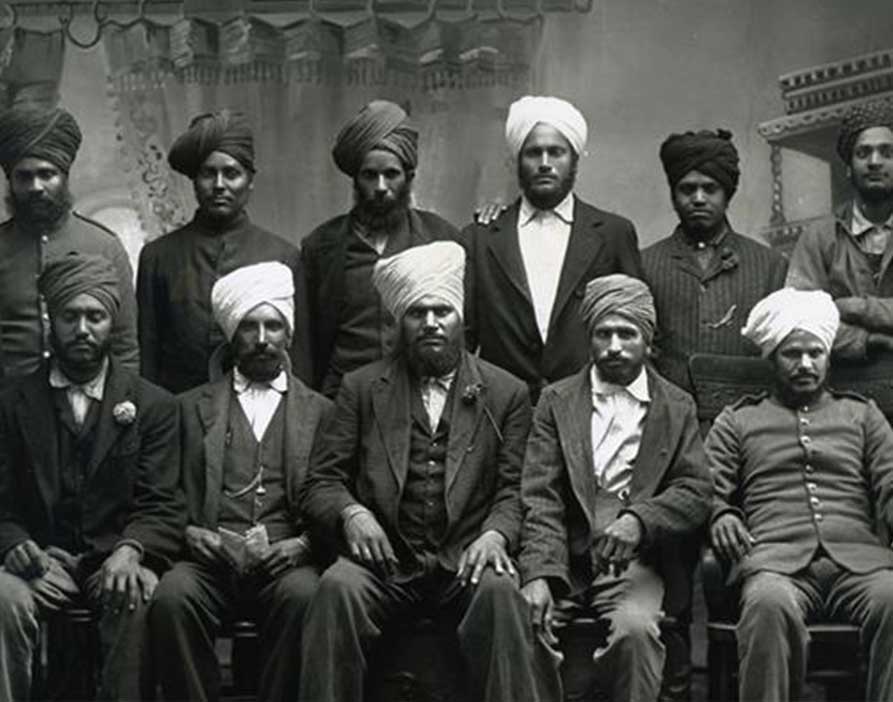
That early movement set the stage for what happened next. Their experience abroad gave them the confidence, skills, and resources to pursue opportunities across the Pacific. They were already familiar with Western customs. Some were proficient in the English language, and possessed enough savings to afford the voyage to places such as Vancouver, Seattle, and San Francisco.
On April 6, 1899, the San Francisco Chronicle reported that four Sikhs arriving on the Nippon Maru were allowed to land at the Port of San Francisco.2 One of them, Bakhshish Singh Dhillon, spoke fluent English. His companions were Boodh Singh, Variam Singh, and Sohava Singh. People from the Indian subcontinent had trickled into the U.S. before, but this landing is the first documented arrival of Sikh pioneers in San Francisco.
Most of the earliest arrivals were retired soldiers of the British Empire who wrote back to their brothers and cousins in their home villages, describing the opportunities they had found in Canada and the United States, encouraging others to follow. Early Ghadar leaders like Sohan Singh Bhakna and Harnam Singh Tundilat narrated that more migrants left Punjab because of crushing taxes, heavy debt to moneylenders, and deep economic hardship. A smaller group of politically active workers fled after participating in the 1906-07 agrarian agitation to avoid capture. In short, economic pressure and political repression together pushed many Punjabis to migrate abroad.3
- Singh, Kesar. Canadian Sikhs and Komagata Maru Massacre. Second Edition ed., Hans Printing Ltd., 1997, pp. 26.
- San Francisco Chronicle – April 6, 1899 – page 10 April 6, 1899 | San Francisco Chronicle | San Francisco California | Page 10
- For an extensive treatment of the economic factors involved in this migration, see Josh, Hindustan Gadar Party, vol.
Many of these newcomers were young men from farming families who had mortgaged their land to finance the journey. Their relatives invested in them with the hope that, once settled in Canada or the United States, these migrants would soon be able to send money home to repay the loans.4
These pioneers undertook a long and costly journey from their villages in Punjab to major Pacific Coast ports of entry, including Seattle (WA), Victoria (BC), Vancouver (BC), and San Francisco (CA). The migration accelerated rapidly by 1907. That year alone, more than 2,000 “East Indians” were officially admitted into the United States, marking the first major wave of Punjabi mostly Sikh arrivals on the Pacific Coast.5
From 1900-1915, about 8,000 people from the Indian subcontinent came to the Pacific Coast but many were denied entry. While a small number of these immigrants were students, merchants, or skilled workers, most were laborers who found work in lumber mills, agriculture, and railroad construction. There were also a few exceptionally successful farmers, including Baba Jawala Singh, the founder of the Stockton Gurdwara in California.
From 1900-1915, about 8,000 people from the Indian subcontinent came to the Pacific Coast but many were denied entry. While a small number of these immigrants were students, merchants, or skilled workers, most were laborers who found work in lumber mills, agriculture, and railroad construction. There were also a few exceptionally successful farmers, including Baba Jawala Singh, the founder of the Stockton Gurdwara in California.
Reaching the Pacific Coast was only half the challenge. After surviving the long journey, these newcomers confronted a second barrier: discrimination, exclusion, and restrictive immigration policies that made admission into either country difficult and uncertain. South Asians faced the highest rejection rate of any group processed at these North American ports. For example, among those who arrived through the San Francisco Angel Island Immigration Station, more than half were denied entry and sent back home between 1911 and 1915.6
AntiAsian laws, reinforced by antagonistic media, shaped public opinion and cast these migrants as unwelcome and undesirable, regardless of their backgrounds or intentions. About 85 to 90 percent of these early migrants were Sikhs, with roughly 10 percent identifying as Muslim. Hindus were only a small minority among them.7 Yet despite their diverse religious identities, prejudiced Americans lumped them all together under the label “Hindu,” a term used not as an accurate description but as a racial slur that erased their distinct cultures and faiths in a dismissive and demeaning way.
These pioneers came to North America in search of opportunity and freedom, only to be met with exclusionary acts and racial discrimination. A well-known incident was one in which various white working-class men attacked the Bellingham East Indian millworker community on September 4, 1907. According to the Bellingham Reveille, “The Hindu riots were orchestrated with the intention of forcibly removing Indian workers from the town and instilling fear in them to prevent them from competing with white workers in the mills.”8
This was the kind of “welcome” the earliest Sikh migrants to North America received.
- Jacoby, Harold S, and Amarjit Singh Bal. History of East Indians in America. B. Chattar Singh Jiwan Singh, 2007, pp. 10.
- Jacoby, Harold S, and Amarjit Singh Bal. History of East Indians in America. B. Chattar Singh Jiwan Singh, 2007, pp.
- Nauman, R. (2024, April 3). Mosaic – South Asian Immigrants | Angel Island Immigration Station – San Francisco. AIISF.
https://www.aiisf.org/mosaic-profiles/southasianimmigrants - Library Guides: Echoes of Freedom: South Asian Pioneers in California, 1899-1965: 1. Punjab, 1899. (n.d.).
https://guides.lib.berkeley.edu/echoes-of-freedom/punjab - The Bellingham Reveille (Bellingham, Wash.), September 5, 1907. “Mob Raids Hindus and Drives Them From City.”
– By Prabhjot Singh
