
Have We Forgotten the Sikhs who Helped Build Canada?
Long before inclusion and acceptance, for Sikhs arriving on the shores of British Columbia, the only certainty awaiting them was labour. Trading one home for another, Sikhs from 1897 started building lives where roots had yet to grow. From the long gruelling days as railway and forestry workers, each story was varied yet bound by a shared hardship. Calluses formed where effort met repetition. Men grew as resolute as the steel tracks they laid for the foundation of the nation. They stood tall like the lumber mills that employed them. We must recognize that the contributions of these men are too vast to be forgotten.
When we think of Sikh Canadian history, what emerged was not sudden. It is rarely permitted to be. The experience of an isolated young worker emerged into a family. Men who first delayed loneliness through letters sent into the void, sat down with a chosen community.
Gurdwaras appeared, small and modest, marked for the first time with the Nishan Sahib. The language of a people lingered in their halls, with the laughter of children who never knew a home before their own in Canada. Those years unfolded into decades, across generations; this rhythm has carried many of us forward.
These stories seem like a distant future when considering the thriving neighbourhoods of Sikh Canadians today. However, this path to the present was not forged free of struggle. Sikh Gurdwaras span across Canada as our places of worship. Gurdwaras anchor communities, providing solace in times of happiness and need. In times of political upheaval, the Gurdwaras served as the grounds for political and social movements.
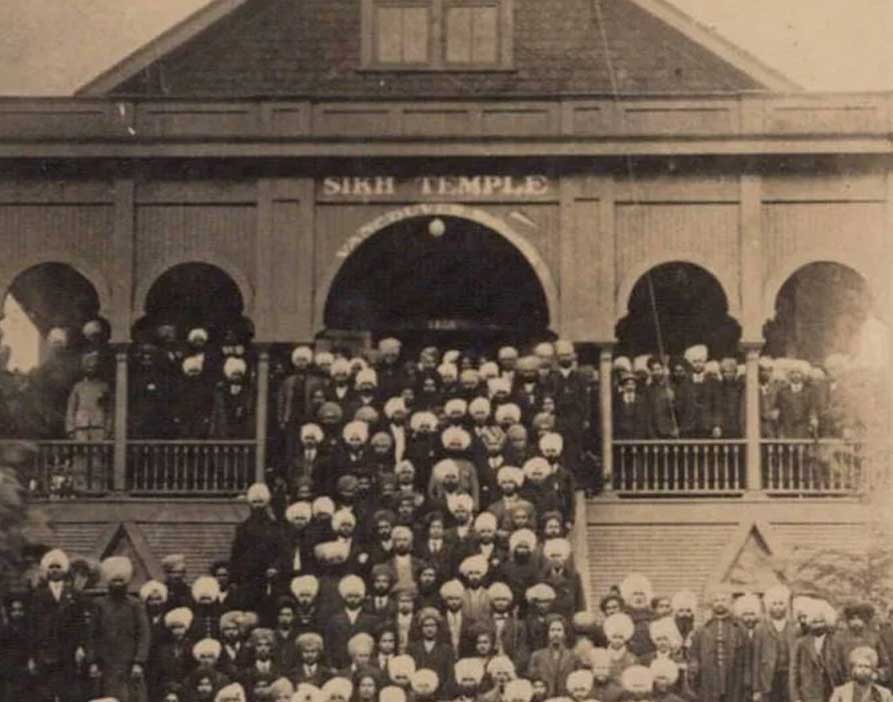
The oldest surviving Gurdwara in Canada, Gur Sikh Temple, was built in Abbotsford in 1911. With donated lumber, Sikh mill labourers carried material to build a place of worship themselves. On the surface, these circumstances highlighted a future of Canadian multiculturalism coming to fruition. A lumber-owning white family donating wood to an underserved religious community. In the 1920s, however, a later context exposed the family’s ties to the Ku Klux Klan, a group promoting white supremacist ideology. Sikh, Japanese and Chinese workers faced heightening hostility and danger through discrimination and job loss perpetuated by pressure from white supremacist groups. As quickly as the prospect of cooperation seemed tangible, the reality of prejudice reared its head. History points out that simplified narratives of multicultural acceptance are perhaps not that simple. Sikhs and adjacent communities have persevered in creating lasting structures despite institutional exclusion, not because of outright acceptance. It is these moments of deep exclusion that underscore the Sikh experience in Canada.
Today, Canadian Sikhs face challenges that they may not have anticipated in 1897. For them, Canada was a place in which religious freedom not only flourished but was a founding principle. A hundred years later, Quebec’s Bill-21, which prohibits the wearing of religious symbols by public employees, erases Canadian Sikhs from the public. Just as many Canadian Sikhs would confirm, for them, their faith requires them to respect all faith traditions and those who choose not to believe.
In many ways, the idea of secularism mirrors the Sikh faith’s worldview on freedom of thought and even freedom from religion. However, Bill-21 not only betrays this secularism but also those early Sikh pioneers who made Canada their home for generations to come.

In our present, the ugly face of racial hatred has once again emerged. In the age of rapid digital communication, stereotypes are shaped by viral moments and misinformation. There is no doubt that immigration issues require robust debate, but when does that spill over to toxic prejudice? Although racist attitudes towards Sikh Canadians arise as seemingly new events, they mirror continuations of previously existing tensions in Canadian society. However, rather than retreat, Sikh Canadians continue forward with the same rhythm. Perseverance through work, labour, community and unwavering faith. Sikhs in Canada today stand not only with open arms to receive lumber but to serve as teachers, nurses, policemen and builders. All these years later, Sikh Canadians continue to build with lumber across the country, laying the foundations for generations they may never meet.
Karam Singh is a writer based in Northern California. He previously studied at UC Berkeley and San Jose State University. He is the co-founder of the California Sikh Youth Alliance, a grass-roots Sikh advocacy organization. Tweet: @karmsinghca
– By Karam Singh
(Sikh Researcher)
Tweet: @karmsinghca
